This milestone turns the raw LaTeX corpus of Milestone 1 into structured data: every version of every paper is parsed into a hierarchy, its content is cleaned and normalized, its bibliography is converted to BibTeX, and identical references and elements are deduplicated across versions. All numbers below are computed from the parse results when the book is built.
1. Pipeline
python -m introds parse processes the corpus paper by paper, in parallel worker processes, and
records the outcome of every version in SQLite so an interrupted run resumes where it stopped.
version folder ──► 1. multi-file gathering (root, \input / \include, comments)
                ──► 2. standardization (math normalization, formatting cleanup)
                ──► 3. hierarchy construction (headings, lists, sentences, formulas, figures)
                ──► 4. bibliography (.bib, \bibitem, .bbl) ──► BibTeX entries
paper (all versions) ──► 5. reference deduplication (one key per reference, \cite renamed)
                     ──► 6. element deduplication (identical cleaned content shares one ID)
                     ──► elements / hierarchy / bibtex
Source
rows = [
    ("Papers", f"{summary['papers']:,}"),
    ("Versions", f"{summary['versions_total']:,}"),
    ("Versions with TeX sources", f"{summary['versions_with_tex']:,}"),
    ("Versions parsed", f"{summary['versions_parsed']:,}"),
    ("Parsing success rate (versions with TeX)", f"{summary['parse_success_rate']:.2%}"),
    ("Versions without TeX (recorded as empty)", f"{summary['versions_total'] - summary['versions_with_tex']:,}"),
]
table(rows, ["", "Value"])2. Multi-file gathering
Root. The publication root is the
.texfile containing\documentclass. When several files declare one (standalone figures, templates), the root is the one with a\begin{document}, then a conventional name (main.tex,ms.tex, ...), then the most\inputs.Compilation path.
\input,\include,\subfileand\importare followed transitively, relative to the root folder (as LaTeX does) and to the including file. Include cycles and missing files are skipped. Every other.texfile in the folder is a redundant auxiliary file and is ignored.Comments.
% ...comments (but not\%),commentenvironments and\iffalse ... \fiblocks are removed before anything else, so a commented-out\inputis plain text and never followed.
Source
multi = summary["versions_multi_file"]
display(Markdown(
    f"**{multi:,}** parsed versions ({multi / max(summary['versions_parsed'], 1):.1%}) are split over "
    f"several `.tex` files; **{summary['versions_with_unused_tex']:,}** contain files outside the "
    f"compilation path (**{summary['unused_tex_files']:,}** files ignored)."
))
fig, ax = plt.subplots()
counts = ok.n_tex.clip(upper=15).value_counts().sort_index()
ax.bar(counts.index.astype(int).astype(str), counts.values, color="#4C72B0")
ax.set(xlabel=".tex files in the version (15 = 15 or more)", ylabel="versions",
       title="Figure 1. Number of .tex files per version")
plt.show()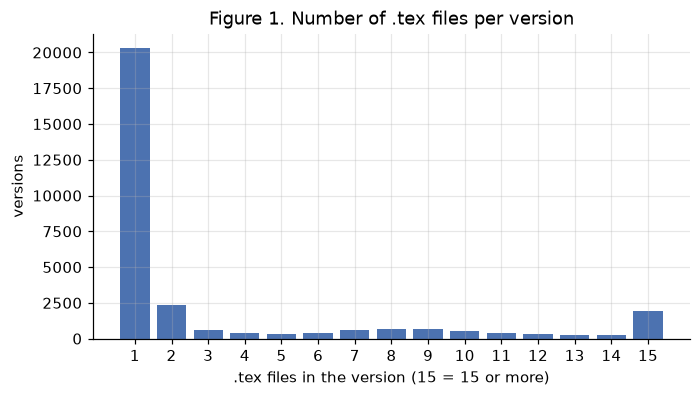
3. Hierarchy construction
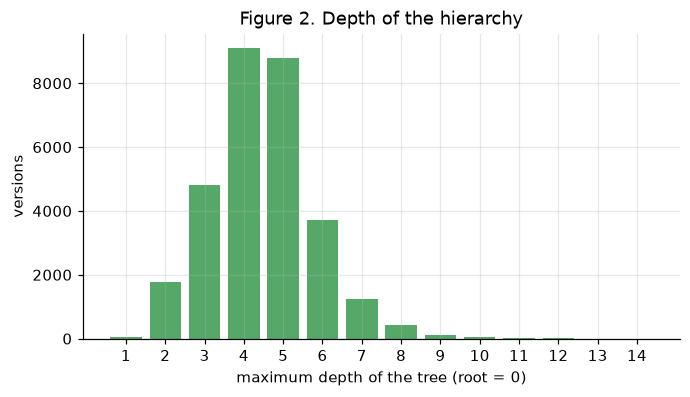
Levels. The document is the root. Sectioning commands (
\part>\chapter>\section>\subsection>\subsubsection>\paragraph>\subparagraph) get their level from the commands the paper actually uses: in a paper without chapters, sections are the second level.Leaves. Prose becomes sentences;
equationblocks become formulas; floats (figure,table,algorithm, code listings, standalonetabular) become figures.Lists. An
itemize(alsoenumerateanddescription) is a list component whose items are the next level; an item contains sentences, formulas or nested lists.Included / excluded. The abstract, acknowledgements (section or environment) and appendices (
\appendix, including unnumbered\section*) are part of the tree. The references section (thebibliography,\bibliography, or a heading titled References / Bibliography) is not.Sentences end at
.,!or?followed by a new sentence, never inside math, commands (\cite{a.b}), URLs, decimal numbers or abbreviations such as e.g., i.e., et al., Fig. 1.
Source
before, after = summary["kinds_before_dedup"], summary["kinds_after_dedup"]
kinds = ["document", "heading", "sentence", "formula", "figure", "list", "item"]
rows = [(k, f"{before.get(k, 0):,}", f"{after.get(k, 0):,}",
         f"{1 - after.get(k, 0) / before[k]:.1%}" if before.get(k) else "-") for k in kinds]
rows.append(("total", f"{summary['nodes_before_dedup']:,}", f"{summary['elements_after_dedup']:,}",
             f"{1 - summary['elements_after_dedup'] / summary['nodes_before_dedup']:.1%}"))
display(Markdown("Tree nodes over all versions, and distinct elements after cross-version deduplication:"))
table(rows, ["kind", "nodes (all versions)", "elements (deduplicated)", "reduction"])Source
fig, ax = plt.subplots()
depth = ok.max_depth.value_counts().sort_index()
ax.bar(depth.index.astype(int).astype(str), depth.values, color="#55A868")
ax.set(xlabel="maximum depth of the tree (root = 0)", ylabel="versions",
       title="Figure 2. Depth of the hierarchy")
plt.show()
display(Markdown(
    f"**{summary['versions_with_appendix']:,}** versions have appendices and "
    f"**{summary['papers_with_acknowledgements']:,}** papers have an acknowledgements heading."
))
4. Standardization
Cleanup. Formatting without semantic meaning is removed:
\centering, float placement options ([htpb]), table rules (\toprule,\midrule, ...), spacing (\vspace,\hspace), font size and style switches,\label, title-page metadata (\author,\affiliation, ...), colour commands and\makeatlettermacro code. Emphasis wrappers keep their text (\textbf{x}→x).Inline math
\( ... \)and\begin{math}become$ ... $.Block math
$$ ... $$,\[ ... \],equation*,displaymathbecome\begin{equation} ... \end{equation}; multi-line environments keep their alignment inside it (align→\begin{equation}\begin{aligned} ... \end{aligned}\end{equation}), so the result is still valid LaTeX.\label,\nonumberand\notagare dropped.
\begin{align*} a &= b \\ c &= d \end{align*}   →   \begin{equation}\begin{aligned}a &= b \\ c &= d\end{aligned}\end{equation}
\[ E = mc^2 \]                                  →   \begin{equation}E = mc^2\end{equation}
\( x_i \)                                       →   $x_i$
5. References
Each version’s bibliography comes from, in this order:
the
.bibfiles named by\bibliography{...}/\addbibresource{...}, keeping only the entries actually cited (as BibTeX does), unless\nocite{*};\bibitementries of athebibliographyenvironment in the TeX, converted to BibTeX with regular expressions: key, authors (first block), title (second\newblock, quotes or emphasis), venue, year, DOI, URL and arXiv identifier (turned into anarxiv.org/absURL), entry type from the venue (In Proceedings →inproceedings, volume/journal →article, publisher →book);the
.bblfile, only when the version has no.bib(natbib\bibitemlists and biblatex\entryrecords are both supported).
Deduplication. Within a paper, entries that share a DOI, a normalized title, or a key are one
reference. The key used by the latest version is kept, every \cite{} of the other keys is renamed
to it, and the fields are unioned (the latest non-empty value wins), so no information is lost:
| version | key | title | author | year | doi |
|---|---|---|---|---|---|
| v1 | vaswani2017 | ✓ | ✓ | ✓ | |
| v2 | vit_transformer | ✓ | ✓ | ✓ | ✓ |
| v3 | vit_transformer | ✓ | ✓ | ||
| unified | vit_transformer | ✓ | ✓ | ✓ | ✓ |
Source
src = summary["bib_sources"]
labels = {"bib": ".bib", "bibitem": "\\bibitem in TeX", "bbl": ".bbl", "none": "none"}
fig, ax = plt.subplots()
items = sorted(src.items(), key=lambda kv: -kv[1])
ax.barh([", ".join(labels.get(p, p) for p in k.split(",")) for k, _ in items], [v for _, v in items], color="#8172B2")
ax.invert_yaxis()
ax.set(xlabel="versions", title="Figure 3. Source of each version's bibliography")
plt.show()
rows = [("Bibliography entries over all versions", f"{summary['entries_before_dedup']:,}"),
        ("Unified entries after deduplication", f"{summary['entries_after_dedup']:,}"),
        ("Reduction", f"{1 - summary['entries_after_dedup'] / max(summary['entries_before_dedup'], 1):.1%}")]
table(rows, ["", "Value"])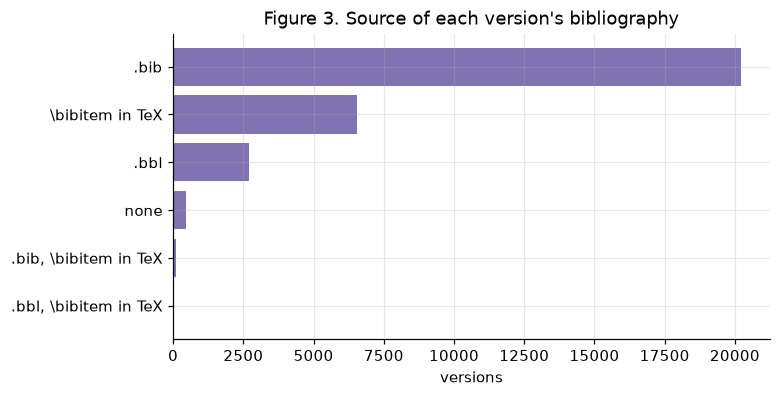
6. Deduplication across versions
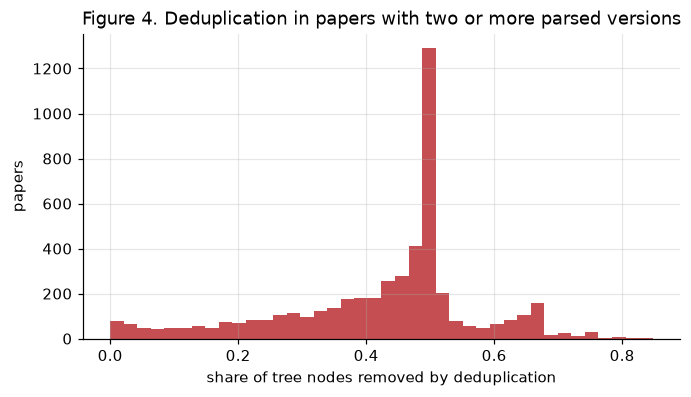
After cleanup and citation renaming, an element whose kind and content match exactly in two
versions is stored once, so a single element_id serves both versions. Each version keeps its own
root (<paper>#root1, <paper>#root2, ...) and its own parent edges, so the same sentence can sit
under different headings in different versions. Element IDs are the publication key followed by a
kind prefix and a counter: h heading, s sentence, e equation, f figure, l list, i item.
The root is its own parent (parent_id is required to be non-null).
Source
multi = papers[papers.n_versions_parsed >= 2]
fig, ax = plt.subplots()
ratio = (1 - multi.n_elements / multi.n_nodes).clip(lower=0)
ax.hist(ratio, bins=40, color="#C44E52")
ax.set(xlabel="share of tree nodes removed by deduplication", ylabel="papers",
       title="Figure 4. Deduplication in papers with two or more parsed versions")
plt.show()
display(Markdown(
    f"For the **{len(multi):,}** papers with at least two parsed versions, deduplication removes "
    f"**{1 - multi.n_elements.sum() / multi.n_nodes.sum():.1%}** of the tree nodes."
))
Explore one paper
The tree below is generated from the parse output. Click a heading, list or item to expand it. Elements shared by several versions show the versions they appear in.
Source
def render(example, version):
    elements = example["elements"]
    edges = [(e, p) for v, e, p in example["hierarchy"] if v == version]
    in_versions = {}
    for v, e, _ in example["hierarchy"]:
        in_versions.setdefault(e, set()).add(v)
    children, root = {}, None
    for e, p in edges:
        if e == p:
            root = e
        else:
            children.setdefault(p, []).append(e)

    def node(e, open_=False):
        kind, content = elements[e]
        tag = f"<code>{html.escape(e.split('#')[1])}</code>"
        shared = sorted(in_versions[e])
        badge = f" <small>(v{', v'.join(map(str, shared))})</small>" if len(shared) > 1 else ""
        text = html.escape(content if len(content) < 300 else content[:300] + " ...")
        if e in children:
            label = f"<b>{kind}</b> {tag}: {text}{badge}"
            inner = "".join(f"<li>{node(c)}</li>" for c in children[e])
            return f"<details{' open' if open_ else ''}><summary>{label}</summary><ul>{inner}</ul></details>"
        return f"<i>{kind}</i> {tag}: {text}{badge}"

    return node(root, open_=True)


if example:
    versions_of_example = sorted({v for v, _, _ in example["hierarchy"]})
    parts = [f"<h4>arXiv:{example['arxiv_id']} - version {v}</h4>" + render(example, v)
             for v in versions_of_example]
display(HTML("<div style='font-size: 0.85em'>" + "".join(parts) + "</div>"))7. Version coverage
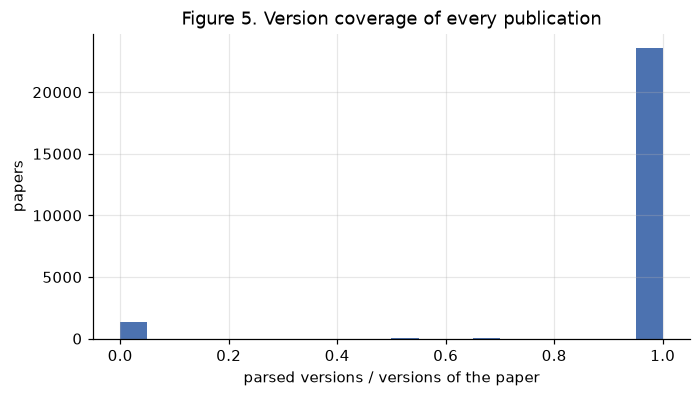
Source
coverage = papers.n_versions_parsed / papers.n_versions
fig, ax = plt.subplots()
ax.hist(coverage, bins=20, color="#4C72B0")
ax.set(xlabel="parsed versions / versions of the paper", ylabel="papers",
       title="Figure 5. Version coverage of every publication")
plt.show()
display(Markdown(
    f"**{summary['papers_full_version_coverage']:,}** of {summary['papers']:,} papers have every "
    f"version parsed (mean coverage {summary['mean_version_coverage']:.1%}). Versions without TeX "
    "(PDF-only or withdrawn) cannot be parsed; they are recorded as empty, not dropped."
))
8. Performance
Measured on Google Colab, CPU-only runtime (2 vCPU Intel Xeon @ 2.20 GHz, 13.6 GB RAM), with one
worker process per CPU. Wall time covers python -m introds parse end to end and is cross-checked
with GNU time -v; RAM is sampled every 2 seconds over the main process and its workers.
Source
rows = [
    ("End-to-end wall time", hms(summary["time_wall_total_s"])),
    ("Average wall time per publication", f"{summary['time_wall_per_paper_s']:.3f} s"),
    ("Average processing time per publication (one worker)", f"{summary['time_per_paper_avg_s']:.3f} s"),
    ("Peak RAM (sampled, all processes)", mb(summary["ram_peak_bytes"] or 0)),
    ("Average RAM (sampled)", mb(summary["ram_avg_bytes"] or 0)),
    ("Output: parsed papers (parsed/*.json.gz)", mb(summary["output_parsed_bytes"])),
    ("Output: elements / hierarchy / bibtex Parquet tables", mb(summary["output_tables_bytes"])),
]
if "Elapsed (wall clock) time (h:mm:ss or m:ss)" in gnu:
    rows.append(("GNU time: elapsed wall clock", gnu["Elapsed (wall clock) time (h:mm:ss or m:ss)"]))
if "Maximum resident set size (kbytes)" in gnu:
    rows.append(("GNU time: maximum resident set size (largest process)",
                 mb(int(gnu["Maximum resident set size (kbytes)"]) * 1024)))
table(rows, ["Measure", "Value"])Source
if len(resources):
    res = resources.sort_values("ts")
    minutes = (res.ts - res.ts.min()) / 60
    fig, ax = plt.subplots()
    ax.plot(minutes, res.rss_bytes / 2**20, color="#C44E52", lw=1)
    ax.set(xlabel="minutes since start", ylabel="RAM (MB)", title="Figure 6. RAM during the parse")
    plt.show()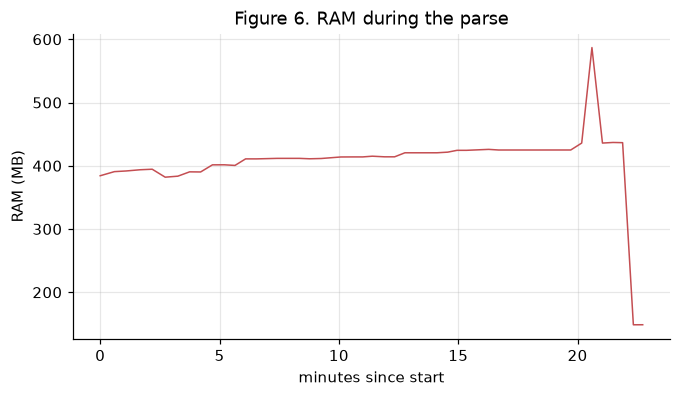
9. Output data
Each paper’s result is kept in parsed/<paper>.json.gz: its distinct elements, the node-parent edges
of every version and its unified BibTeX entries, so the final tables are built without parsing
again. A version without TeX sources yields no elements and stays recorded as empty. The three tables
below are exported as sharded Parquet for the final dataset, published with Milestone 3.
Source
for name in ("elements", "hierarchy", "bibtex"):
    t = tables[name]
    display(Markdown(f"**{name}**: {t['rows']:,} rows in {t['shards']} Parquet shard(s)"))
    display(table([(c["name"], c["type"], "yes" if c["nullable"] else "no", str(t["sample"].get(c["name"]))[:80])
for c in t["columns"]], ["column", "type", "nullable", "example"]))10. Limitations
The parser is regular-expression based, not a TeX engine: user macros (
\newcommand) are not expanded, and unusual document classes may hide structure in custom commands.Sentence splitting is rule based; very long “sentences” usually come from text without final punctuation (lists of items, captions).
\bibitemconversion relies on the usual\newblocklayout; free-form references may get an incomplete title or venue.
11. References
Lab Instructors, Milestone 2 statement.
BibTeX, natbib, biblatex and REVTeX documentation: the bibliography formats read in Section 5.
amsmath documentation: multi-line math inside
equation(Section 4).Python documentation:
reandmultiprocessing.Apache Parquet and Hugging Face dataset configuration: the output tables (Section 9).
12. Requirements checklist
| Requirement (Milestone 2 statement) | Where |
|---|---|
| Every version of every paper parsed; versions without TeX recorded as empty | 1, 7, 9 |
Root file, transitive \input / \include, commented commands ignored, auxiliary files ignored | 2, Figure 1 |
| Hierarchy: document root, automatic levels, sentences, block formulas, figures, tables as figures | 3, Figure 2 |
| Lists and items; references section excluded; acknowledgements and appendices included | 3 |
| Sentence splitting that respects math, commands, abbreviations, URLs and decimals | 3 |
| Formatting cleanup | 4 |
| Inline and block math normalized | 4 |
\bibitem converted to BibTeX | 5, Figure 3 |
Reference deduplication: one key, \cite renamed, fields unioned | 5 |
| Full-text deduplication across versions, after cleanup | 6, Figure 4 |
Element IDs; elements, hierarchy and bibtex tables | 6, 9 |
| Parsing success rate | 1 |
| Version coverage of every publication | 7, Figure 5 |
| Element and entry counts before and after deduplication | 3, 5 |
| End-to-end wall time and average time per publication | 8 |
| Maximum RAM and final output size, on Colab CPU-only | 8, Figure 6 |
| Figures and tables generated during book compilation | every figure and table on this page |